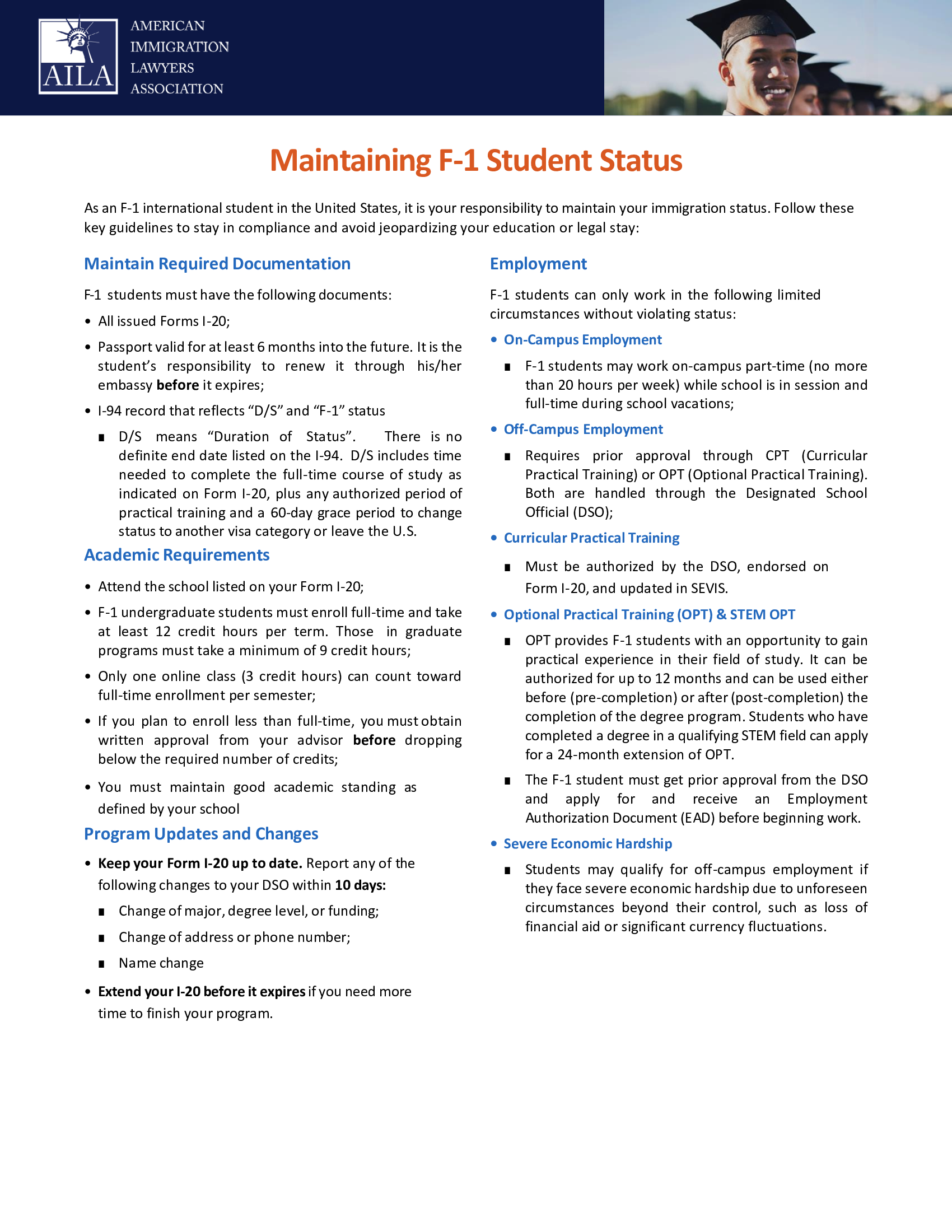
The Department of Homeland Security (DHS) issued a final rule that significantly changes how F-1 students, J-1 exchange visitors, and many I media visa holders maintain lawful status in the United States. Previously, these individuals were generally admitted for “Duration of Status” (D/S). Under the new rule, they will instead receive fixed periods of admission, typically limited to the program end date and generally not exceeding four years.
DHS emphasizes that the four-year period is intended as a law enforcement and screening tool to assess whether a student is maintaining normal academic progress and eligibility for F-1 status.
Key Changes to Duration of Status
- Fixed Admission Periods: F and J nonimmigrants will no longer be admitted for Duration of Status. Maintaining status will depend on the expiration date on the individual’s I-94 record, not solely on SEVIS program dates.
- Extension Applications Required: Students and exchange visitors whose programs extend beyond four years will need to file an Extension of Stay application with USCIS before their authorized stay expires.
- Shorter F-1 Grace Period: The post-completion grace period for F-1 students has been reduced from 60 days to 30 days, requiring earlier planning for departure, transfers, or changes of status.
- Dependent Family Members Affected: When family members file extension applications together, the approved stay for all applicants may be limited by the family member with the shortest eligible period, such as the earliest passport expiration date.
- New Rules for I Visa Holders: Most foreign media representatives will be admitted for a maximum of 240 days rather than D/S and may need to file extension requests or depart and reenter the United States to continue their activities,
Additional Changes applicable to F-1 and J-1 nonimmigrant
- The F-1 student who timely files an EOS may continue pursuing their full course of study after the expiration of the admission period until USCIS adjudicates the EOS application.
- Generally, an F-1 student must complete their first academic year of a program at the school that initially issued their I-20.
- The rule prohibits F-1 students at the graduate level from changing educational objectives at any point during their program of study. “Educational Objectives” refers to a student’s education level or major.
- Prohibits F-1 students at the graduate level from transferring at any point during their program of study, unless an exception is authorized by SEVP for extenuating circumstances.
- F-1 students must progress to higher educational levels and are prohibited from changing to the same or a lower educational level while an F-1 student.
- J-1 nonimmigrants who are employment authorized with a specific employer incident to status can continue to be authorized for such employment for up to 240 days if their status expires while their timely filed OES application is pending.
- J-2 dependents must apply for an EAD do not have continued work authorization once their EAD expires.
- J-1s whose D/S status expires shortly after the rule takes effect can file an EOS and continue to work for the duration of the time on their new DS-2019 regardless of how long USCIS takes to adjudicate the EOS application.
- The EOS application will require evidence of sufficient funds to cover expenses for the extended period of time.
Transition Period
- The transition period can last up to 4 years for students who were admitted for D/S prior to the rule’s effective date and are properly maintaining F and J status on 9/15/2026.
- During this transition period, F or J nonimmigrants in D/S on 9/15/2026 do not need to have their I-94 corrected to a date certain, provided they continue their studies appropriately.
- They can continue in D/S until the program end date in their I-20 or DS-2019 or 4 years after 9/15/2026, whichever comes first. They remain entitled to the 60-day grace period as part of the transition period.
- Should they travel abroad during this period, they will be issued a new I-94 with a date certain upon their return.
- F-1 students with D/S who have filed Form I-765 for post-completion OPT or STEM OPT on or before March 18, 2027, will not have to file an EOS. If the F-1 has a date-certain I-94, they have to file the I-765 and the EOS application.
Unlawful Presence (ULP) After Duration of Status
- Calculation of the accrual of ULP resulting from the elimination of D/S will not be applied retroactively, but for those with completed programs and expired I-20s, ULP will begin to accrue on 9/15/2026 unless they have applied prior to 9/15/2026 for reinstatement, a change of status, or an EAD for OPT or STEM OPT.
______________
These are highlights only from the new rule. We will update the website as more information becomes available. If you are an F-1 or J-1 nonimmigrant, work closely with your DSO regarding your status and seek advice from immigration counsel when needed.