
Posts in India (including Hyderabad and Chennai), Ireland and Vietnam thus far have been unilaterally rescheduling visa appointments currently scheduled on or after December 15, 2025, many to March 2026 or later.
Limited Rescheduling: Applicants who cannot attend on the new date may reschedule online, but are limited to one opportunity to reschedule. Fee receipts older than one year are considered expired and cannot be used to reschedule. Missing or canceling the rescheduled appointment may result in forfeiture of the fee.
If you travel abroad in anticipation of a visa appointment, be prepared to remain abroad for an extended period of time. Monitor your appointment portals for any updated appointment letters or other notifications.
This change, effective 9/6/2025, eliminates the ability to apply for a nonimmigrant visa in a third country which often resulted in shorter wait times or was more convenient based on personal or business reasons.
Applicants who schedule nonimmigrant interviews at a U.S. embassy or consulate outside of their country of nationality or residence might find that it will be more difficult to qualify for the visa. Fees paid for such applications will not be refunded and cannot be transferred.
Exceptions include applicants for A, G, C-2, C-3, NATO visas, and applicants for diplomatic-type visas. Rare exceptions may be made for humanitarian or medical emergencies or foreign policy reasons.
Because this is a new policy, we have yet to see how or if exceptions will be made on a discretionary basis.
A requirement for naturalization has always been establishing good moral character. This remains a significant factor but the review process is changing. Previously, USCIS primarily relied upon a satisfactory financial history (e.g., verifying that the applicant has complied with tax obligations and child support payments) and no past misconduct (such as unlawfully voting, making false claims to citizenship, or criminal activities).
The changes USCIS announced include restoring “robust” vetting for all applicants and stricter reviews of disability exceptions to the English and civics requirements. USCIS will also be looking for positive contributions to American society instead of a mere absence of bad behavior. The agency is resuming neighborhood investigations to ensure that applicants meet statutory requirements and are worthy of U.S. citizenship. Other recent policies include clarifying that unlawfully voting, unlawfully registering to vote, and making false claims to U.S. citizenship disqualify applicants from showing good moral character.
USCIS is also changing the civics and government test, which is conducted orally. Applicants who file Form N-400 on or after Oct. 20, 2025 must take the 2025 civics test. Applicants who filed before that date will take the 2008 naturalization civics test.
The 2025 test will include administering 20 test questions (instead of the previous 10) wherein the applicant must get 12 correct (versus the previous 6 correct answers). An applicant fails the test if they have 9 incorrect answers.
More information can be found here: https://www.uscis.gov/citizenship/find-study-materials-and-resources/check-for-test-updates.
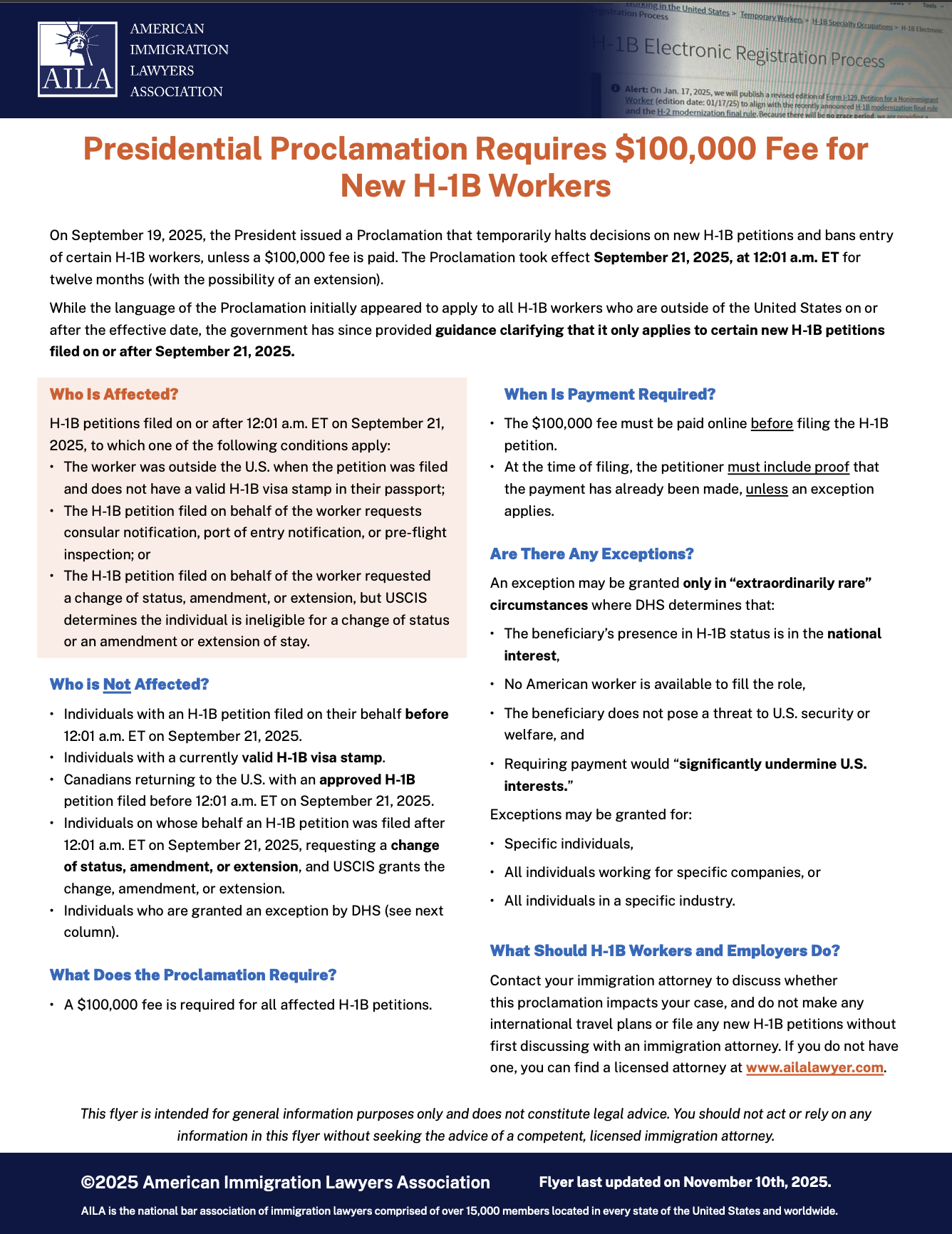
USCIS and U.S. Customs and Border Protection posted Memos on 9/20/2025 seeking to clarify the recently issued Proclamation. While the Memos appear to provide some clarity, confusion and inconsistency regarding the Proclamation and its implementation abound.
USCIS Memo dated 9/20/2025 states the following:
The USCIS memo also states that the proclamation “does not impact the ability of any current visa holder to travel to or from the United States.” Even so, until we have more clarity on this proclamation, my advice remains for nonimmigrants not to travel outside of the U.S.
The U.S. Customs and Border Protection Memo dated 9/20/2025 essentially states the same information as the USCIS memo.
A White House Fact Sheet on the Proclamation states the following:
Other points and considerations at this time:
Exceptions: There may be exceptions for an individual, a company, or an industry, if DHS determines that it is in the national interest of the U.S. and does not pose a threat to the security or welfare of the U.S. The language of the Proclamation does not address whether this new fee and travel restriction apply to cap-exempt H-1B workers outside of the U.S.
_________
We will continue to monitor the situation and provide updates as they become available.
President Trump issued a proclamation restricting the entry of anyone seeking to enter or reenter the U.S. in H-1B status without payment of a new $100,000 fee. The proclamation, titled Restriction on Entry of Certain Nonimmigrant Workers, is effective at 12:01 a.m. EDT Sunday, September 21, 2025.
Any H-1B nonimmigrants who are currently abroad should return to the U.S. as soon as possible before the effective date. Travel outside of the U.S. for visa processing/renewals will be impacted so H-1B nonimmigrants should refrain from all international travel until implementation is further clarified.
There may be exceptions for an individual, a company, or an industry, if DHS determines that it is in the national interest of the U.S. and does not pose a threat to the security or welfare of the U.S.
Universities are cap exempt. The language of the Proclamation does not address whether this new fee and travel restriction apply to cap-exempt H-1B nonimmigrants outside of the U.S. Until we receive clarification, it is advised that all H-1B nonimmigrants postpone international travel.
We will provide updates as more information becomes available.
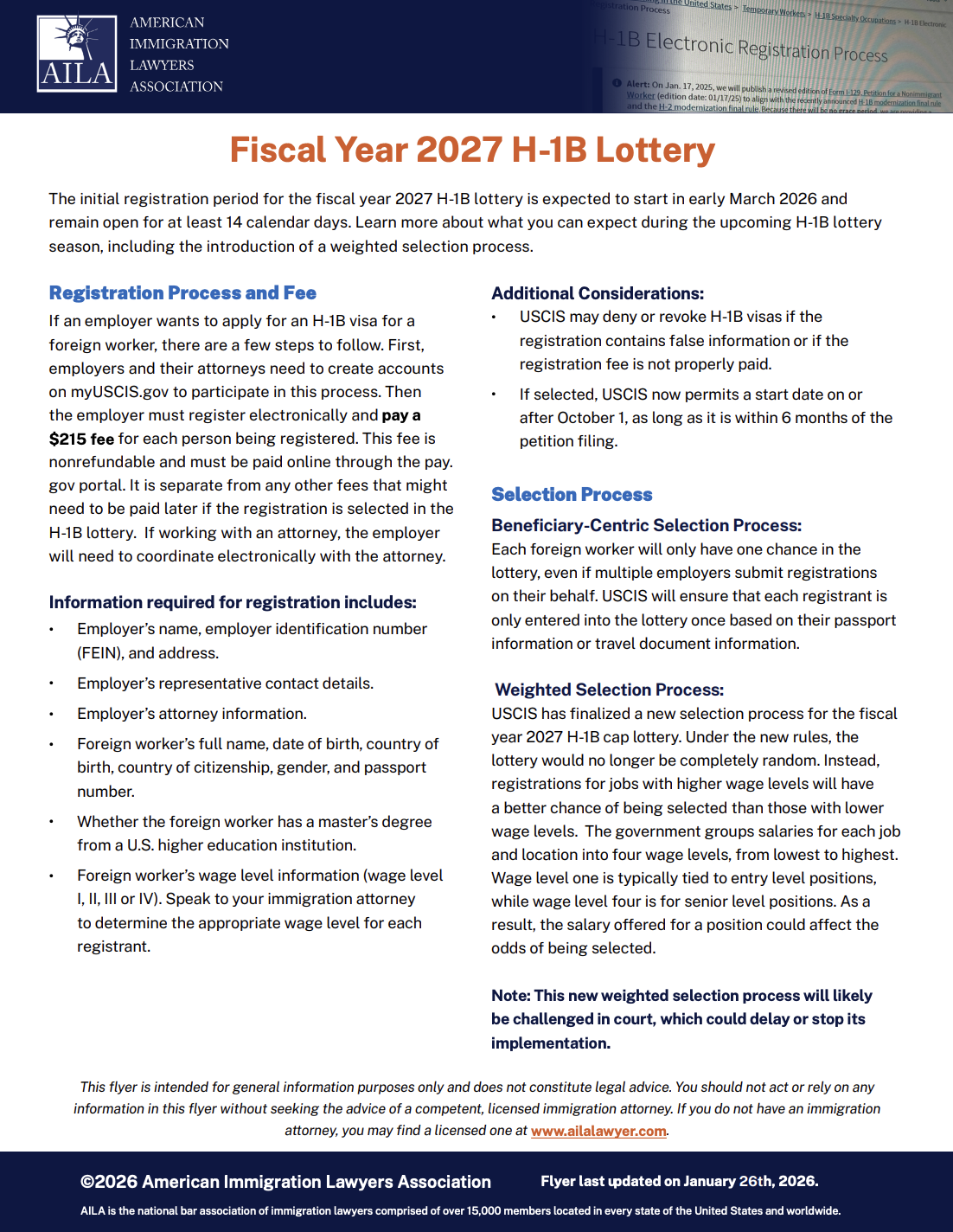
On July 18, 2025, USCIS announced it had received enough petitions to hit the H-1B visa cap for FY 2026. This includes the standard 65,000 visas and an additional 20,000 set aside for applicants with advanced degrees from U.S. schools.
With the cap now closed, thousands of skilled foreign professionals—and the companies that rely on them—must either wait for the next cycle or begin searching for alternatives. Employers who filed after the cap now risk having their petitions rejected. It forces businesses to reassess their hiring plans, especially in industries such as tech, engineering, and healthcare, which heavily rely on global talent. Workers not selected in this round now face hard choices. Some may try to extend their current status, such as F-1 OPT. Others might switch to a different visa category. But for many, this marks yet another year of career uncertainty.
Those already on H-1B visas, however, still have options. They can extend their stay, transfer to a new employer, or change job details. These types of petitions do not count toward the cap and are still being processed. It’s one of the few ways the system allows for some movement—though even that comes with limits. Once again, the yearly H-1B quota has run out long before the need has. The widening gap between immigration policy and workforce needs is creating challenges for talented professionals and the employers eager to hire them. If you have questions about your H-1B case or want to prepare for a future filing, feel free to reach out to our office.